
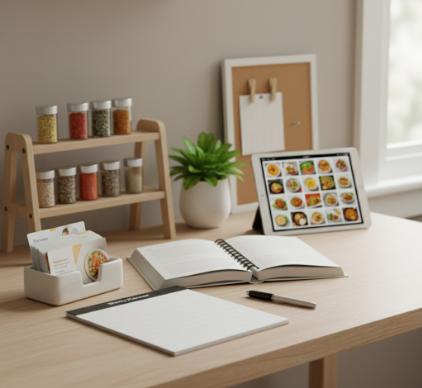
I used to think meal planning was something organized people did with color-coded spreadsheets and matching Tupperware.
Then I cleared out my kitchen desk area last winter—you know, that weird corner where the mail piles up next to half-empty spice jars and sticky notes from 2019—and found seventeen printed recipes I’d completely forgotten about, three expired coupons for ingredients I never bought, and a shopping list that just said “healthy stuff.” Turns out, I wasn’t failing at meal planning because I lacked discipline; I was failing because I had no system to actually capture what I learned each week. The recipes I loved got buried under takeout menus. The grocery lists I started never made it to the store. And every Sunday night, I’d start from scratch, scrolling through the same recipe blogs, forgetting what I’d already tried, what my partner hated, what took three hours when the blog promised thirty minutes. It was like having a broken bookmark—I kept losing my place in my own cooking life. Honestly, the mental load wasn’t the planning itself; it was the constant re-planning, the decisions made and then immediately forgotten because they lived on crumpled paper or in browser tabs I’d close before extracting any wisdom from the experience.
Here’s the thing: your kitchen desk area doesn’t need to be Instagram-perfect. Mine’s still a little messy. But it does need to be functional in a very specific way—it needs to hold your planning system in a format your actual tired Tuesday brain can use, not your aspirational Saturday morning brain.
Why Your Recipe Collection Is Probably Working Against You Right Now
Most people collect recipes like I used to collect interesting rocks as a kid—impulsively, with vague future intentions, in a pile that grows until it stops meaning anything. You tear pages from magazines. You bookmark food blogs. You screenshot Instagram posts. And then what? The average home cook has access to, I don’t know, maybe 40,000 recipes online at any moment, give or take, but actually rotates through about nine meals. That gap—between infinite possibility and actual behavior—lives in your kitchen desk area as clutter, and in your brain as decision fatigue. I’ve seen people with entire binders of printed recipes they’ve never made once, organized by cuisine type, tabs and everything, sitting next to the same five delivery menus they actually use. The problem isn’t insufficient access to recipes; it’s that we treat recipe collection as the endpoint instead of the starting line. Wait—maybe that’s too harsh. Let me reframe: collecting is fine, but without a retrieval system that accounts for your real constraints (time, skill, what’s actually in your fridge on Thursday), it’s just food Pinterest.
Creating a Command Center That Actually Matches How You Think About Food
So what works? For me, it’s a three-part system on my desk: a magnetic board with this week’s dinners (just the names, nothing fancy), a small basket with recipe cards I’ve actually made and rated, and a running grocery list on my phone that syncs with my partner. That’s it.
The magic isn’t in the tools—you could do this with a notebook and a pen—it’s in the workflow: every Sunday, I look at my calendar, check what’s already in the pantry, pull 4-5 recipe cards from my “proven” basket, write those meal names on the board, and generate the grocery list from there. When I make something new, I immediately write notes on the recipe card while I’m still annoyed about how long the onions actually took to caramelize (not five minutes, Susan, never five minutes). If it’s good, it goes in the basket. If it’s meh, it goes in the recycle bin—no guilt, no “maybe someday.” This sounds simple, and it definately is, but it took me probably two years to accept that meal planning isn’t about having the perfect system; it’s about having a system you’ll actually maintain when you’re exhausted and hungry. The desk area just keeps everything in one place so Future Tired You doesn’t have to think about where things are.
The Weird Psychological Relief of Externalizing Food Decisions Just a Little Bit
There’s this phenonemon researchers talk about called decision fatigue—basically, every choice you make depletes a finite mental resource, and food decisions are relentless because they come three times a day, every day, forever. When I started using my desk command center, I noticed something unexpected: I wasn’t just saving time, I was reclaiming a kind of mental peace I didn’t realize I’d lost. Tuesday arrives, I glance at the board, I see “black bean tacos,” and my brain doesn’t have to do anything except execute. No debate. No scrolling. No “what sounds good right now” spiral that ends in pizza again. I guess what I’m trying to say is that organizing your meal planning space isn’t really about the recipes or the pretty containers—though those help—it’s about outsourcing just enough cognitive labor that cooking stops feeling like a nightly crisis negotiation with yourself. Some weeks I still order takeout. Some weeks the board stays blank. But most weeks, having that external structure sitting on my desk, visible and simple, means I actually cook, and I actually eat food I feel okay about, and honestly that’s enough. The desk area became less about organization and more about self-compassion, which sounds ridiculous for a spot where I keep grocery lists and old takeout chopsticks, but here we are.




