I burned three omelets last Tuesday before realizing my pan’s nonstick coating had basically given up on life.
The thing about nonstick surfaces is they’re not actually magic—they’re polymers, usually polytetrafluoroethylene, which everyone calls Teflon even though that’s technically a brand name, kind of like how people say Kleenex for tissues. These coatings work because they create a microscopically smooth barrier between your egg proteins and the metal surface, preventing molecular adhesion. When eggs hit a hot pan, proteins denature and want to bond with whatever’s available; on bare metal they’ll grab onto microscopic scratches and pits, but on proper nonstick the fluoropolymer molecules are so tightly packed and chemically inert that proteins just slide around looking for purchase they’ll never find. The first Teflon pans showed up in the 1960s, and honestly we’ve been chasing that same basic chemistry ever since, though modern versions layer the coating differently—some use three or four separate applications, building up from a primer coat that grips the aluminum to a top layer optimized for slipperiness.
Here’s the thing: not all nonstick is created equal, and omelet pans specifically need different properties than, say, a sauté pan. The ideal omelet surface has to release a thin egg layer that’s only maybe two millimeters thick without tearing, which requires an almost obsessive level of smoothness.
Anyway, there’s this whole debate about ceramic versus traditional nonstick, and I used to think ceramic was automatically better because it sounds more natural or whatever. Ceramic coatings are typically silicon dioxide-based, marketed as PFOA-free and eco-friendly, and they do work—at first. The problem is they’re more porous at the microscopic level, which means they lose their slickness faster, sometimes within six months of regular use. Traditional PTFE coatings, assuming they’re applied properly and not heated above roughly 500°F (manufacturers say 450-500, give or take), can last two to three years. I’ve seen ceramic pans that were spectacular for exactly eight weeks, then turned into egg-sticking nightmares. Turns out durability matters more than I wanted to admit.
Wait—maybe I should mention thickness too.
The pan’s base metal actually matters as much as the coating itself, because heat distribution determines whether your omelet cooks evenly or develops those weird rubbery spots while other parts stay runny. Aluminum conducts heat about four times better than stainless steel, which is why most omelet pans use aluminum bodies, sometimes with a stainless or copper core for added stability. A good nonstick omelet pan typically has a base that’s at least 3mm thick—thinner than that and you get hot spots where the coating degrades faster from thermal stress. The French have this traditional carbon steel omelet pan approach where you season it like cast iron, building up polymerized oil layers, and while that works beautifully it requires maintainence and a willingness to accept that your first dozen omelets will probably stick until the seasoning develops. Most people, myself included, don’t have that kind of patience on a Wednesday morning when you just want eggs.
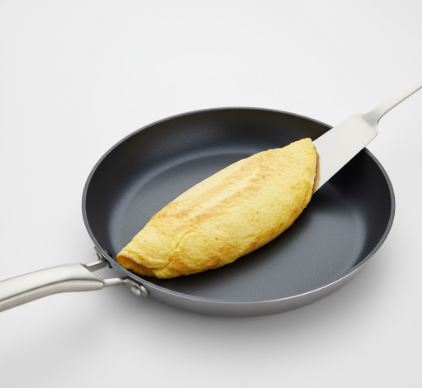
The folding moment is where everything either works or falls apart, literally.
Professional chefs use this flicking wrist motion that looks effortless but actually depends on the pan’s sloped sides and the exact coefficient of friction between egg and surface—too much stick and the omelet tears, too little and you can’t control it. I guess it makes sense that omelet pans have those gently curved sides, usually at a 20-30 degree angle, specifically designed to guide the fold. The nonstick coating has to maintain consistent performance across the entire surface, including where the sides meet the base, because that transition zone is where your spatula (or gravity, if you’re fancy) initiates the fold. When that coating starts to fail, it almost always happens there first, in the curve, because that’s where utensils scrape most often and where temperature variations create stress. Some manufacturers now use reinforced coatings with titanium or diamond particles embedded in the polymer matrix, which sounds like marketing nonsense but actually does improve scratch resistance—though honestly, if you’re using metal utensils on nonstick you’re kind of missing the point anyway.
Modern coatings like Quantanium or Swiss Diamond claim to withstand metal utensils, and while they’re definitely more durable, I still wouldn’t reccomend testing that theory with a fork every morning. The longevity of any nonstick surface depends on how you treat it: hand washing instead of dishwashers, medium-low heat instead of blasting it, wood or silicone tools instead of metal. Heat degrades the polymer bonds over time no matter what, but abuse accelerates it exponentially.
There’s something almost meditative about a perfectly nonstick pan—the way butter or oil spreads in one smooth motion, how eggs release without resistance, that satisfying slide when you tilt the pan and everything just moves. Until it doesn’t, and then you’re scrubbing egg residue and wondering if you should’ve bought the more expensive one.