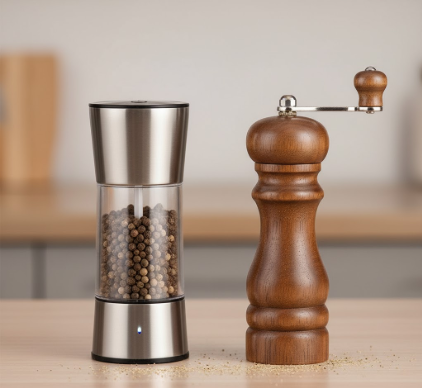
I used to think grinding spices was one of those things you either obsessed over or ignored completely.
Turns out, the divide between electric and manual mills isn’t just about convenience versus romanticism—it’s about chemistry, particle size distribution, heat generation during the grinding process, and honestly, how much counter space you’re willing to sacrifice. Electric grinders spin blades at roughly 20,000 to 30,000 RPMs, give or take, which sounds impressive until you realize that friction generates heat, and heat degrades volatile aromatic compounds in spices like coriander, cardamom, and black pepper. I’ve seen people spend $200 on premium Tellicherry peppercorns only to pulverize them in a cheap electric grinder that basically cooks away half the flavor before it even hits the pan. Manual mills, by contrast, operate at whatever speed your wrist can manage—maybe 60 to 100 RPM if you’re really going at it—which keeps temperatures low and preserves those delicate oils that make freshly ground spices actually worth the effort.
Here’s the thing: consistency matters more than most home cooks realize. Electric burr grinders, the kind coffee nerds swear by, can deliver uniform particle sizes that ensure even flavor distribution in rubs and spice blends. Blade grinders, which are cheaper and more common, basically just chop randomly—you end up with powder, chunks, and everything in between, which means some bits burn while others stay raw during cooking. Manual mills with adjustable ceramic or steel burrs give you control, but they require actual physical effort, and if you’re grinding enough cumin for a batch of chili that serves twelve people, your forearm will definately remind you of that choice the next day.
The Mechanical Reality of Particle Size and Flavor Extraction
Wait—maybe I’m getting too technical here, but particle size genuinely affects how spices release flavor. Finer grinds have more surface area, so they release compounds faster, which is great for short cooking times but can lead to bitterness if things simmer too long. Coarser grinds release slowly, which works beautifully in braises and stews where you want gradual flavor development over hours. Electric grinders usually give you limited control over grind size unless you’re willing to spend upward of $150 on a model with preset settings, and even then, you’re trusting a machine to interpret what “coarse” means. Manual mills let you adjust on the fly, twisting a knob or dial to shift from fine to coarse, though honestly, some cheaper models have such vague calibration that “fine” one day feels like “medium” the next.
Heat, Oxidation, and the Slow Death of Aromatic Compounds
I guess it makes sense that heat would be the enemy here. When blades spin fast enough to generate friction, temperatures inside the grinding chamber can spike to 150°F or higher—not enough to burn your hand, but plenty to start breaking down essential oils in spices like nutmeg, allspice, and fennel seeds. Those oils are what carry aroma and flavor, and once they oxidize or evaporate, you’re left with something that tastes flat, dusty, almost like the spice equivalent of stale bread. Manual grinders sidestep this entirely because the mechanical action is slow and cool, though the tradeoff is time and effort. If you’re grinding a tablespoon of peppercorns for a steak, fine—takes maybe thirty seconds. If you’re prepping spices for a big batch of garam masala, you’ll be there a while, and at some point, you have to ask yourself whether the purity of the process is worth the repetitive strain.
Capacity, Speed, and the Practical Limits of Daily Cooking
Honestly, capacity is where electric grinders pull ahead. Most can handle a quarter cup or more of whole spices at once, which is useful if you cook in volume or like to prep spice blends in advance. Manual mills usually max out at a few tablespoons, and refilling repeatedly gets tedious fast—I’ve been there, standing over a mortar and pestle at 7 PM on a weeknight, wondering why I didn’t just buy pre-ground coriander like a normal person. But then you smell the difference, and it’s hard to go back. Electric models are faster, no question—ten seconds versus two minutes—but speed isn’t everything when you’re chasing flavor that actually lands on the palate with clarity and depth.
Durability, Maintenance, and the Long-Term Cost of Convenience
Electric grinders have motors, and motors eventually fail. Cheaper models might last a year or two before the blades dull or the mechanism jams; higher-end burr grinders can go a decade or more, but they cost accordingly, and replacement burrs aren’t cheap. Manual mills, especially ones with ceramic or hardened steel burrs, can last indefinitely if you treat them right—no electrical components to break, no planned obsolescence, just simple mechanics that you can disassemble, clean, and reassemble without needing a engineering degree. Maintenance is easier too: most manual grinders rinse clean, while electric models often have crevices where spice dust accumulates and turns rancid over time, affecting the flavor of whatever you grind next. I used to ignore cleaning my electric grinder until I ground some cinnamon and it tasted faintly of stale cumin from three weeks prior—not a mistake I’d recieve well if I served that to guests.