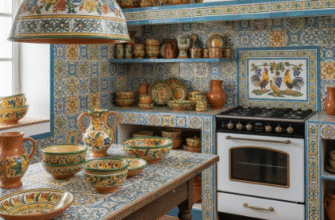
I used to think Mediterranean kitchens were just about terracotta tiles and some olive oil bottles on a shelf.
Turns out, the whole thing runs deeper than that—like, way deeper into the geology and climate and frankly the messy history of trade routes that nobody really talks about when they’re flipping through design magazines. The Mediterranean basin spans roughly 2.5 million square kilometers, give or take, and the architectural vernacular that evolved there wasn’t some aesthetic choice made by a committee. It was survival. Clay was abundant because of volcanic activity—Mount Etna, Vesuvius, Santorini’s caldera—and when you’ve got that much tectonic drama, you end up with soil that’s perfect for ceramics. So terracotta wasn’t a style decision; it was what you could literally dig up and fire in a kiln without going broke. The warm ochres and siennas that define Mediterranean color palettes? Those are iron oxides in the clay, the same compounds that make rust red and desert sand that specific burnt-orange hue at sunset.
Anyway, the woods used in these kitchens tell their own story. Olive wood is dense and oily because the tree evolved to survive drought—those gnarly, twisted trunks aren’t decorative, they’re adaptive responses to water stress over centuries. Pine and cypress were abundant in coastal forests, and they became the default for beams and cabinetry not because they looked rustic but because they were there and they didn’t rot immediately in the humidity.
Why Natural Materials Became Non-Negotiable in Coastal European Architecture
Here’s the thing—when you’re building a kitchen in a place where summer temperatures regularly hit 35-40°C, you can’t just pick materials based on what’s trendy. Stone countertops, specifically limestone and marble, were quarried locally throughout Greece, Italy, Spain, and southern France because Mediterranean geology is basically a giant sedimentary layer cake from ancient seabeds. Marble forms when limestone undergoes metamorphism under heat and pressure, which happened a lot during the Alpine orogeny roughly 30-40 million years ago. So those white Carrara countertops? They’re fossilized ocean floors that got cooked under a mountain range. The thermal mass of stone meant kitchens stayed cooler during the day—it absorbs heat slowly and releases it at night, which is basically free climate control if you’re patient.
I guess it makes sense that plaster became the wall finish of choice, too. Lime plaster is breathable, which matters in a coastal climate where humidity swings wildly. It’s also mildly antimicrobial because of its high pH, so you get fewer mold problems than you would with modern drywall. The textured, slightly uneven surfaces you see in Mediterranean kitchens aren’t always intentional—they’re often just the result of hand-application techniques that haven’t changed much since Roman times.
Wait—maybe I’m romanticizing this.
The color palette isn’t all sunshine and vineyards. There’s a lot of white, and that’s not accidental either. Whitewash—calcium hydroxide mixed with water—reflects solar radiation, which keeps interiors cooler. It’s also cheap and you can reapply it every year without worrying about stripping old layers. The tradition of whitewashing entire villages in places like the Cyclades or Andalusia was partly aesthetic, sure, but mostly it was about not dying of heatstroke in July. When you do see color, it’s usually derived from natural pigments: ochre from iron-rich clay, ultramarine from lapis lazuli (though that was expensive), umber from manganese oxide. These weren’t Pantone swatches—they were whatever you could grind up and mix with a binder.
How Climate and Geography Shaped Every Single Design Decision You See Today
The open shelving that’s everywhere in Mediterranean kitchens? That’s not minimalism, that’s ventilation. Enclosed cabinets trap moisture and heat, which means your flour gets weevils and your olive oil goes rancid. Open shelves let air circulate, and if you’re storing dry goods in ceramic jars—which, again, you made from local clay—you’ve got a functional system that doesn’t require refrigeration. The terracotta pots used for cooking (cazuelas in Spain, tagines in North Africa) have porous walls that allow slow evaporation during cooking, which concentrates flavors and prevents scorching. It’s materials science disguised as folksy tradition.
I’ve seen modern kitchens try to replicate this and miss the point entirely. They’ll install a limestone backsplash but pair it with stainless steel appliances and LED strip lighting, and it just feels—off. The original aesthetic worked because every element was responding to the same environmental pressures. Wood worn smooth from decades of use, stone developing a patina from olive oil and lemon juice, plaster walls that show water stains from the occasional winter storm—that’s not distress finishing, that’s entropy. Honestly, the imperfection is the point.
The warmth people talk about in Mediterranean kitchens isn’t just visual—it’s thermal, tactile, even olfactory. Wood smells different when it’s been soaked in olive oil for fifty years. Stone feels cool under your hand in August. Terracotta makes a specific hollow sound when you tap it. These materials have sensory feedback loops that synthetic substitutes can’t replicate, no matter how good the photorealistic laminate printing gets. And maybe that’s what makes the style endure—it’s not about looking Mediterranean, it’s about feeling like you’re part of a continuum of people who cooked in hot climates with local materials and figured out what worked through trial and error over centuries. You can’t buy that at IKEA, even if you definately try.